Jaime Guillermo Carbonell (July 29, 1953 – February 28, 2020) was a computer scientist who made seminal contributions to the development of natural language processing tools and technologies. His research in machine translation resulted in the development of several state-of-the-art language translation and artificial intelligence systems. He earned his B.S. degrees in Physics and in Mathematics from MIT in 1975 and did his Ph.D. under Dr. Roger Schank at Yale University in 1979. He joined Carnegie Mellon University as an assistant professor of computer science in 1979 and moved to Pittsburgh. He was affiliated with the Language Technologies Institute, Computer Science Department, Machine Learning Department, and Computational Biology Department at Carnegie Mellon. His interests spanned several areas of artificial intelligence, language technologies and machine learning. In particular, his research focused on areas such as text mining (extraction, categorization, novelty detection) and in new theoretical frameworks such as a unified utility-based theory bridging information retrieval, summarization, free-text question-answering and related tasks. He also worked on machine translation, both high-accuracy knowledge-based MT and machine learning for corpus-based MT (such as generalized example-based MT). == Career == Carbonell was the Allen Newell Professor of Computer Science and head of the Language Technologies Institute at Carnegie Mellon University. He joined Carnegie Mellon in 1979, and became a key faculty member in the artificial intelligence area. He was appointed full professor in 1987, Newell Chair in 1995, and University Professor in 2012. He completed his undergraduate studies at MIT. He received dual degrees in Mathematics and Physics. He received his Ph.D. in computer science from Yale University in 1979. At the time of his appointment, Carbonell was the youngest chaired professor in the School of Computer Science at CMU. His research spanned several areas of computer science, mostly in artificial intelligence, including: machine learning, data and text mining, natural language processing, very-large-scale knowledge bases, translingual information retrieval and automated summarization. He wrote more than 300 technical papers and gave over 500 invited or refereed-paper presentations (colloquia, seminars, panels, conferences, keynotes, etc.). He died following a long illness on February 28, 2020. Mona Talat Diab became the director of CMU's Language Technologies Institute in 2023. == Research == Carbonell created MMR (maximal marginal relevance) technology for text summarization and informational novelty detection in search engines, invention of transformational analogy, a generalized method for case-based reasoning (CBR) to re-use, modify and compose past successful plans for increasingly complex problems and knowledge-based interlingual machine translation. He was instrumental in setting up the Computational Biolinguistics Program, a joint venture between Carnegie Mellon and the University of Pittsburgh, which combines Language Technologies and Machine Learning to model and predict genomic, proteomic and glycomic 3D structures. Carbonell also did work in machine learning. He organized the first four machine learning conferences, starting with CMU in 1981. The Language Technologies Institute (LTI), founded and directed by Carbonell, achieved top honors in multiple areas. These areas include machine translation, search engines (including founding of Lycos by Michael Mauldin, one of Carbonell’s PhD students), speech synthesis, and education. LTI remains the original, largest and best-known institute for language technologies, with over $12M in annual funding and 200 researchers (faculty, staff, PhD students, MS students, visiting scholars etc.). Carbonell made major technical contributions in several fields, including (1) Creation of MMR (maximal marginal relevance) technology for text summarization and informational novelty detection in search engines,(2) Proactive machine learning for multi-source cost-sensitive active learning, (3) Linked conditional random fields for predicting tertiary and quaternary protein folds, (4) Symmetric optimal phrasal alignment method for trainable example-based and statistical machine translation, (5) Series- anomaly modeling for financial fraud detection and syndromic surveillance, (6) Knowledge-based interlingual machine translation, (7) Robust case-frame parsing, (8) Seeded version-space learning and (9) Invention of transformational and derivational analogy, generalized methods for case-based reasoning (CBR) to re-use, modify and compose past successful plans for increasingly complex problems. The teams led by Carbonell achieved top honors in many areas such as first scalable high-accuracy interlingual machine translation (1991), first speech-to-speech machine translation (1992), first large-scale spider and search engine (1994), and first trainable, large-scale protein-structure topology predictor (2005). Modern machine learning, co-founded by Carbonell, Michalski and Mitchell, is a fundamental enabling technology in search engines, data mining and social networking. Starting in 1980, he co-edited the first three books on ML, launched the ML conferences and was a co-founder and editor-in-chief of ML Journal. Carbonell’s innovations have led to several successful start-ups: Carnegie Group (AI expertsystems), Lycos (web search), Wisdom (financial optimization & ML), Carnegie Speech (spoken-language tutoring), Dynamix (data mining and pattern discovery), and Meaningful Machines (context-based machine translation). Carbonell was the founding director of The Language Technology Institute, the preeminent global institution in language studies, unparalleled in size and scope and has since been adopted/imitated in Germany (DFKI), Japan (Tokyo Univ.), and the US (Johns Hopkins). == Awards and honors == Okawa Prize, 2015 Best paper award, “Translingual Search” w/Yang, International Joint Conference on AI, 1997 Allen Newell endowed chair, Carnegie Mellon University, 1995 Elected fellow of AAAI, 1991 Computer Science teaching award, Carnegie Mellon University, 1987 Sperry Fellowship for excellence in AI research, 1986 Herbert Simon teaching award, 1986 "Recognition of Service" award from the ACM for the SIGART presidency, 1983–1985 Provided congressional testimony on machine translation, 1990 == Selected works == === Books === 1983. (with Ryszard S. Michalski & Tom M. Mitchell, Eds.) Machine learning: An artificial intelligence approach. Los Altos, CA: Morgan Kaufmann. 1986. (with Ryszard S. Michalski & Tom Mitchell, Eds.) Machine learning: An artificial intelligence approach. Vol. II. Los Altos, CA: Morgan-Kaufmann. 1986. (with Ryszard S. Michalski & Tom Mitchell, Eds.) Machine Learning: A Guide to Current Research. Kluwer Academic Publishers. == Contributions == “Protein Quaternary Fold Recognition Using Conditional Graphical Models” IJCAI 2007 (w/Liu et al.) “Context-Based Machine Translation” AMTA 2006 (w/Klein et al.) “SCRFs: A New Approach for Protein Fold Recognition,’’ Journal of Computational Biology, 13,2, 2006 (w/Liu et al) “MT for Resource-Poor Languages Using Elicitation-Based Learning” Machine Translation, 2004 ‘‘Learning Approaches for Detecting and Tracking News Events,’’ IEEE Trans I.S., 14, 4, 2000 (w/Yang)
Data administration
Data administration or data resource management is an organizational function working in the areas of information systems and computer science that plans, organizes, describes and controls data resources. Data resources are usually stored in databases under a database management system or other software such as electronic spreadsheets. In many smaller organizations, data administration is performed occasionally, or is a small component of the database administrator’s work. In the context of information systems development, data administration ideally begins at system conception, ensuring there is a data dictionary to help maintain consistency, avoid redundancy, and model the database so as to make it logical and usable, by means of data modeling, including database normalization techniques. == Data resource management == According to the Data Management Association (DAMA), data resource management is "the development and execution of architectures, policies, practices and procedures that properly manage the full data lifecycle needs of an enterprise". Data Resource management may be thought of as a managerial activity that applies information system and other data management tools to the task of managing an organization’s data resource to meet a company’s business needs, and the information they provide to their shareholders. From the perspective of database design, it refers to the development and maintenance of data models to facilitate data sharing between different systems, particularly in a corporate context. Data Resource Management is also concerned with both data quality and compatibility between data models. Since the beginning of the information age, businesses need all types of data on their business activity. With each data created, when a business transaction is made, need data is created. With these data, new direction is needed that focuses on managing data as a critical resource of the organization to directly support its business activities. The data resource must be managed with the same intensity and formality that other critical resources are managed. Organizations must emphasize the information aspect of information technology, determine the data needed to support the business, and then use appropriate technology to build and maintain a high-quality data resource that provides that support. Data resource quality is a measure of how well the organization's data resource supports the current and the future business information demand of the organization. The data resource cannot support just the current business information demand while sacrificing the future business information demand. It must support both the current and the future business information demand. The ultimate data resource quality is stability across changing business needs and changing technology. A corporate data resource must be developed within single, organization-wide common data architecture. A data architecture is the science and method of designing and constructing a data resource that is business driven, based on real-world objects and events as perceived by the organization, and implemented into appropriate operating environments. It is the overall structure of a data resource that provides a consistent foundation across organizational boundaries to provide easily identifiable, readily available, high-quality data to support the business information demand. The common data architecture is a formal, comprehensive data architecture that provides a common context within which all data at an organization's disposal are understood and integrated. It is subject oriented, meaning that it is built from data subjects that represent business objects and business events in the real world that are of interest to the organization and about which data are captured and maintained.
It's the Most Terrible Time of the Year
It's the Most Terrible Time of the Year is an AI-generated television commercial created for McDonald's Netherlands by TBWA\Neboko and The Sweetshop. It was released on 6 December 2025 before being pulled four days later due to negative reception over its use of generative artificial intelligence and its cynical, negative depiction of the holiday season. == Plot == On a bleak, snowy day, various people in the city experience different kinds of mishaps during the Christmas season. Among other incidents, families struggle with their huge loads of presents; Santa Claus gets stuck in traffic; a Christmas tree "redecorates" a man's home, sending him through the window; another family puts up with annoying relatives and a burnt Christmas dinner. Because of all this chaos, a man decides to find refuge in a McDonald's outlet. A Christmas choir finishes singing the jingle "It's the Most Terrible Time of the Year" with the call to action to "hide out in McDonald's till January's here". == Campaign == It's the Most Terrible Time of the Year is a 45-second television commercial made by Dutch agency TBWA\Neboko with involvement of United States-based film production studio The Sweetshop. The advertisement was produced heavily with generative artificial intelligence (AI) following the trend set by other brands such as Coca-Cola and Toys "R" Us. McDonald's Netherlands, the client, released a statement that the commercial was meant to depict "the stressful moments during the holidays in the Netherlands". The commercial also used Andy Williams's "It's the Most Wonderful Time of the Year" with lyrics changed to fit with the concept of the advertisement. According to The Sweetshop, the production of the advertisement took "seven weeks". It also added that much effort was put into the commercial compared to the traditional process. Ten people of its in-house AI engine The Gardening Club worked on the project. Los Angeles-based directors Mark Potoka and Matt Spicer were initially credited to be involved in the film but they resigned due to being sidelined from the production process. == Reception == The advertisement was released on McDonald's Netherlands' YouTube channel on 6 December 2025. It had a negative reception over the use of generative AI and the "cynical" concept of the work's story. The video was made private on 9 December 2025. The Sweetshop stated that the production of the advertisement took human effort. McDonald's Netherlands, while stating the original intent of the commercial, released a statement after its pullout that, for many of its customers, the holiday season is the "most wonderful time of the year".
DEAP (software)
Distributed Evolutionary Algorithms in Python (DEAP) is an evolutionary computation framework for rapid prototyping and testing of ideas. It incorporates the data structures and tools required to implement most common evolutionary computation techniques such as genetic algorithm, genetic programming, evolution strategies, particle swarm optimization, differential evolution, traffic flow and estimation of distribution algorithm. It is developed at Université Laval since 2009. == Example == The following code gives a quick overview how the Onemax problem optimization with genetic algorithm can be implemented with DEAP.
Fuzzy classification
Fuzzy classification is the process of grouping elements into fuzzy sets whose membership functions are defined by the truth value of a fuzzy propositional function. A fuzzy propositional function is analogous to an expression containing one or more variables, such that when values are assigned to these variables, the expression becomes a fuzzy proposition. Accordingly, fuzzy classification is the process of grouping individuals having the same characteristics into a fuzzy set. A fuzzy classification corresponds to a membership function μ C ~ : P F ~ × U → T ~ {\textstyle \mu _{\tilde {C}}:{\tilde {PF}}\times U\to {\tilde {T}}} that indicates the degree to which an individual i ∈ U {\textstyle i\in U} is a member of the fuzzy class C ~ {\textstyle {\tilde {C}}} , given its fuzzy classification predicate Π ~ C ~ ∈ P F ~ {\textstyle {\tilde {\Pi }}_{\tilde {C}}\in {\tilde {PF}}} . Here, T ~ {\textstyle {\tilde {T}}} is the set of fuzzy truth values, i.e., the unit interval [ 0 , 1 ] {\textstyle [0,1]} . The fuzzy classification predicate Π ~ C ~ ( i ) {\textstyle {\tilde {\Pi }}_{\tilde {C}}(i)} corresponds to the fuzzy restriction " i {\textstyle i} is a member of C ~ {\textstyle {\tilde {C}}} ". == Classification == Intuitively, a class is a set that is defined by a certain property, and all objects having that property are elements of that class. The process of classification evaluates for a given set of objects whether they fulfill the classification property, and consequentially are a member of the corresponding class. However, this intuitive concept has some logical subtleties that need clarification. A class logic is a logical system which supports set construction using logical predicates with the class operator { ⋅ | ⋅ } {\textstyle \{\cdot |\cdot \}} . A class C = { i | Π ( i ) } {\displaystyle C=\{i|\Pi (i)\}} is defined as a set C of individuals i satisfying a classification predicate Π which is a propositional function. The domain of the class operator { .| .} is the set of variables V and the set of propositional functions PF, and the range is the powerset of this universe P(U) that is, the set of possible subsets: { ⋅ | ⋅ } : V × P F → P ( U ) {\displaystyle \{\cdot |\cdot \}:V\times PF\rightarrow P(U)} Here is an explanation of the logical elements that constitute this definition: An individual is a real object of reference. A universe of discourse is the set of all possible individuals considered. A variable V :→ R {\textstyle V:\rightarrow R} is a function which maps into a predefined range R without any given function arguments: a zero-place function. A propositional function is "an expression containing one or more undetermined constituents, such that, when values are assigned to these constituents, the expression becomes a proposition". In contrast, classification is the process of grouping individuals having the same characteristics into a set. A classification corresponds to a membership function μ that indicates whether an individual is a member of a class, given its classification predicate Π. μ : P F × U → T {\displaystyle \mu :PF\times U\rightarrow T} The membership function maps from the set of propositional functions PF and the universe of discourse U into the set of truth values T. The membership μ of individual i in Class C is defined by the truth value τ of the classification predicate Π. μ C ( i ) := τ ( Π ( i ) ) {\displaystyle \mu C(i):=\tau (\Pi (i))} In classical logic the truth values are certain. Therefore a classification is crisp, since the truth values are either exactly true or exactly false.
YrWall
YrWall is a Digital Graffiti Wall developed by event company Luma, where designs are created on a large wall using a modified spray paint can. The can contains no paint, instead it has an IR light which is tracked by a computer vision system and the image immediately back-projected onto the wall. The inbuilt YrWall software has much of the functionality of a typical computer paint program, with a pop-out interface which enables users to change colour, spray width, opacity, work with stencils and use animated items such as swirls, stars, drips and splats. Recent additions to YrWall include options to email a JPEG of the completed design and create personalised stickers and T-shirts. == Dragons' Den == The inventor of YrWall, Tom Hogan, and his business partner, Tim Williams, appeared on Episode 4 of Series 8 of the BBC show Dragons' Den. Seeking investment in YrWall, the entrepreneurs were successful in gaining £50,000 for 40% of the YrWall parent company Lumacoustics from Dragons Deborah Meaden and Peter Jones. == World's Largest Interactive Graffiti Wall == In September 2009 YrWall was used to create the 'World's Largest Interactive Graffiti Wall' at the Bristol Festival, UK. Artists used the standard 3.5 m2 YrWall to produce artwork which was in turn projected live onto a 26m x 10m space on the side of the iconic Lloyds amphitheatre building.
For a Breath I Tarry
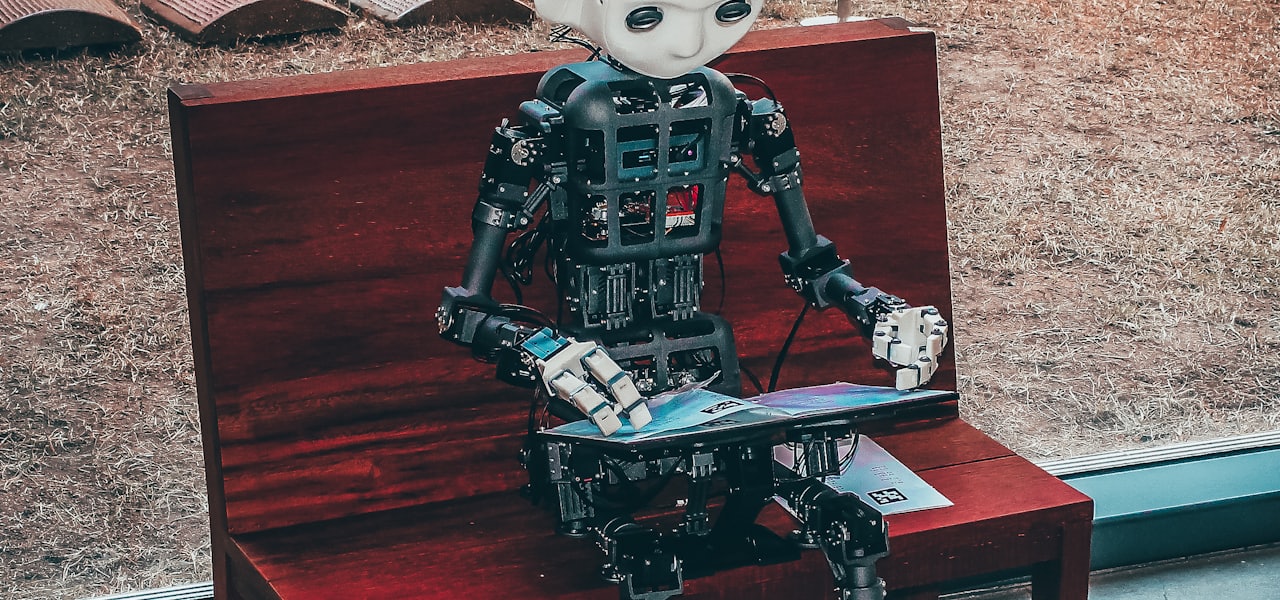
"For a Breath I Tarry" is a 1966 post-apocalyptic novelette by American writer Roger Zelazny, which was nominated for the Hugo Award for Best Novelette in 1967. Set in a future long after the self-extinction of humanity, the novelette recounts the tale of Frost, a sentient machine. Although humans have caused their own extinction, the sentient machines that they created continue the work of rebuilding a shattered Earth. Along the way, the story explores the differences between humanity and machines, the former experiencing the world qualitatively, while the latter doing so quantitatively. This difference is illustrated through philosophical conversations between Frost and another machine named Mordel. Frost's goal of becoming human, along with literary allusions, drives the plot and sets the tone of the novelette. These allusions include the first chapter of the Book of Job, in both situation and language, since verses are both quoted directly and paraphrased. In addition, the first three chapters of the Book of Genesis are echoed. Finally, Frost and Mordel enter into a Faustian bargain, though with better results than in the original story. The other major character is the Beta Machine, Frost's peer in the Southern Hemisphere. (Frost controls the Northern Hemisphere.) The novelette hints that though being a machine, Beta has a feminine personality. After Frost has succeeded in his millennium-long quest to become human (via recovered DNA), Beta agrees to join him in becoming human—suggesting the possibility of rebirth for the human race. The novelette has appeared in collections of Zelazny's works and in anthologies. The title is from a phrase in the poet A. E. Housman's collection A Shropshire Lad.